|

e*duce (-ds, -dys)
verb. e·duced, e·duc·ing, e·duc·es
1)
To draw or bring out; elicit; evoke; evolve; develop. As in: At
first the new firefighter was frightened to enter the burning building,
but he finally educed the courage. 2) To help others bring out the
best in themselves." As in, The firefighter was educed to enter
the burning building by the courage shown by those who went in before
him.

bri·co·lage (brk-läzh, brk-) \bree-koh-LAHZH
noun
Construction,
something made, or put together using whatever materials
happen to be available. As in: The crow's nest was a bricolage of
twigs, string and even the remnants of an old sock.

Act of keeping a balance,
or state of being balanced.
According to Jean
Piaget, equilibration is also the process that drives the development
and acquisition of knowledge.
We are frequently
faced with new events or situations that cannot be fully handled
by our existing understanding. This creates a state of disequilibrium,
or an imbalance between what is understood and what is encountered.
We naturally try to reduce such imbalances by focusing on the stimuli
that causes the disequilibrium, and then developing new schemes
or adapting old ones until equilibrium is restored. This process
of restoring balance is called equilibration. According to Piaget,
it is essential to learning.
Equilibration involves
striking a balance between yourself and your environment, between
assimilation of new ideas and information and accommodation of those
new concepts.
At this time, when
the equilibrium of so many of us is upset, we have the rich opportunity
to grow and develop by accommodating new perspectives, and reach
new and deeper understanding of the world around us.
From Piaget's
Theory Applied to an Early Childhood Curriculum. Cecelia Lavatelli.
(American Science and Engineering, 1973)
Also introduced in
User-centered
Learning: An Interview with Judee Humburg by Marcia Conner (LiNE
Zine, Winter 2001)

Flustered to the point
of incompetence. [adjective]
Have you ever been
supervised so closely, nagged so incessantly, watched so intently
by a critic, spouse, or boss that your performance grew sloppier
as you went along? In English, you might say you were "flustered"
or "jittery." In Yiddish, you would say you were "farblonged."
Neither of these words, however, puts any blame on the unwanted
supervisorial attention that brings on this nervousness and disintegration
of composure in the first place. The German fisselig (rhymes with
"thistle fish") conveys a temporary state of inexactitude
and sloppiness that is elicited by another person's nagging. It
is the precise answer to the unkind question "What the heck
is wrong with you today?"
Everyone has been
in a classroom in which the teacher managed to intimidate students
into speechlessness, whether or not they knew the material. Spouses
trying to teach their mate how to drive an automobile often exhibit
a streak of this trait. Call these not-so-helpful advisers fisseligers.
If someone who has driven you over the edge of your ability to
cope then asks you what is wrong, reply, "I'm fisseliged."
Your tormenter either will be stunned into puzzled silence or
else will feed you your straight line by asking, "What is
that supposed to mean?"
From They
Have a Word for It: A Lighthearted Lexicon of Untranslatable Words&
Phrases Howard Rheingold (Sarabande Books, 2000)
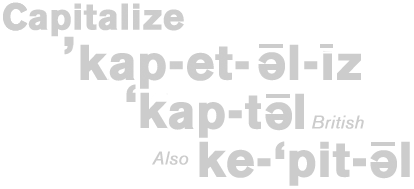
vb
–ized; -izing vt (1850)
1:
To write or print with an initial capital or in capitals 2
a: to convert into capital b: to treat as capital rather
than expense 3 a: to compute the present value of b: to
convert into an equivalent capital sum 4: to supply capital
for ~ vi: to gain by turning something into
advantage: profit
When
our executives fail to mentally capitalize the employees,
viewing them as negative numbers on an expense sheet, our office
suffers a human recession.
With
tax season in full swing we need to review our development costs
to insure we have capitalized all of our development time.
It
is amazing how she always lands on her feet; she capitalizes
very opportunity that comes her way.

\dü-‘en-(,)da\
n Spanish (1964): the power to attract through personal magnetism
and charm
He
is the worst leader organizationally, but his duende brings
in new hires while veterans will follow him anywhere.
Even
the duende of the world’s most successful entrepreneur could
not make her see the value of investing in human capital.

\säk-‘däl-I-jer\
n [perth. Alter. Of doxology] (ca. 1830)
1:
something that settles a matter: a decisive blow or answer:
FINISHER 2: something outstanding or exceptional
An
eye for when to encourage growth and when to promote struggle is
the quintessential sockdolager in human capital management.
The
product was solid, but the visible strength of the company's integrity
was the sockdologer that sealed the deal.
His
black suit was nicely pressed, his white shirt was clean and well
starched, and his tie was of the power variety, but when
he crossed his leg he exposed the sockdolager: his neon purple
socks!

\'kren-ye-let, -,lat\
or crenulated \-,lated\ adj [NL crenulatus,
fr. crenula, dim. of
ML crena] (1794) : having irregularly
wavy or serrate outline <a ~ shoreline> - crenulation
\,kren-ye-let, -'latshen\ n
*
Today
we see more crenulate space in advertising because nothing
is quite as clear as it used to be.
The crenulated or serrated design of the edge of a check
allows for easy detachment from the checkbook.
The crenulation of the border of the screen design
softens the sharp feel, while making a connection that flows into
the focus of the total design.
Internet businesses have crenulate stability these
days, which gives a market impression that the new economy can only
drive in circles.
Vibrato is one technique used to crenulate sound when playing
a musical instrument or singing.

\,ot-ō-‘dī-,dakt, dī-, -de–‘\ n.; adj.
autodidactic [Gk
autodidaktos self-taught, fr. aut-
+ didaktos taught, fr.
didaskein to teach] (1748): a self-taught
person
An
autodidact at the piano; she learned to play purely by ear.
Self-accessible
information on the Internet could create a society of autodidacts;
the question is, though, what quality of autodidacts will we be?
Autodidactic
Profiles: Self-educated People Who've Made a Difference http://www.autodidactic.com/profiles.htm

\In`cu*nab"u*lum\, n.; pl. Incunabula.
[L. incunabula cradle, birthplace, origin. See 1st In-,
and Cunabula.]
A work of art or of human industry, of an early epoch; especially,
a book printed before a. d. 1500.
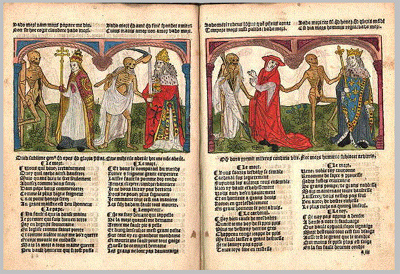
Learn more at http://www.incunabula.org
Copyright (c) 2000-2004
LiNE Zine (www.linezine.com)
LiNE
Zine retains the copyright in all of the material on these web pages
as a collective work under copyright laws. You may not republish,
redistribute or exploit in any manner any material from these pages
without the express consent of LiNE Zine and the author. Contact
linezine@agelesslearner.com
for reprints and permissions. You may, however, download or print
copyrighted material for your individual and non-commercial use.
|

 print
article
print
article