eLearning
seems the perfect answer to today’s business needs, especially
for large global businesses who have to train and retrain people
constantly across national boundaries. The technology is there
and so is the knowledge. But it’s not working well. Although most
countries are increasing their use of elearning, growing evidence
shows that the learners are not happy.
At
elearning orientation seminars in the UK we attended, we found
a strong theme of distrust and of “not invented here.” In some
globally deployed programs we examined, user feedback explicitly
mentions culturally insensitive content. Drop-out rates are very
high. Andy Sadler’s research in 1999 suggested dropout rates as
high as 85%, figures that have not improved significantly according
to Forrester Research
(80%). Masie Center research
shows that 62% of users preferred other methods and a Campaign
for Learning (UK) report said that 12% of elearning content was
“terrible.”
There
are many reasons for this apparent lack of enthusiasm: poor technology
infrastructures in some regions; lack of design expertise; fear
of technology on the part of users, and so on. But there's one
readily identifiable cause that seems to go ignored: lack of cultural
adaptation. Based on extensive anthropological and cross-cultural
research, we suggest that the lack of cultural adaptation is a
leading reason why elearning fails to work for a globally distributed
audience.
Culture
and Learning
“We
learn from experiencing phenomena (objects, events, activities,
and processes), interpreting these experiences based on what we
already know, reasoning about them, and reflecting on the experiences
and the reasoning. Jerome Bruner called this process meaning making.”
—David H. Jonassen
Cultural
difference has been deeply researched. The Dutch anthropologist
Geert Hofstede defines culture as consisting of patterns of “thinking,
feeling, and potential acting” that all people carry within themselves,
and which he terms “mental programs.” The source of these programs
lies within the social environments where people grew up and collected
their life experiences. Culture affects who we are, how we think,
how we behave, and how we respond to our environment. Above all,
it determines how we learn.
The
field of constructivist learning extends that by showing that
learners, based on their own mental categories (schemata), construct
knowledge. They weave new information into a mental network of
existing relationships. For learning to be effective, learning
activities should be relevant to the learners' interests and background
and should occur in settings that mimic authentic ones. Ignoring
cultural factors leads inevitably to frustrating and ultimately
ineffective learning experiences.
Researchers
agree that humankind's cultural make-up is layered. Cross-culturalist
Fons Trompenaars illustrates the idea of cultural layers using
the image of an onion: the outer cultural levels are the most
visible and the easiest to change, whereas the inner core that
determines our cultural assumptions is hidden from view, more
difficult to identify, and not easily changed.
What
about global Internet culture? Internet culture appears to operate
very much at the outer layers, rather like global brands. So although
learners in Chile, Zimbabwe, Australia, Switzerland and the Ukraine
might all be wearing Nike trainers, listening to U2, eating burgers,
and browsing on Internet Explorer, the key aspects of their cultural
identity—including how they learn—may be fundamentally different.
On
a practical level, any professional trainer who has worked in
different cultures will tell you that, to be effective, you’ll
need an understanding of each individual culture. For example,
open-ended, participative workshops don’t work as well in cultures
such as Japan and Holland where people feel most threatened by
uncertain or unknown factors. Motivational techniques that work
well in individualistic cultures (like the US), are guaranteed
to alienate collective cultures (like India). Group assessment
techniques that work well in cultures such as the UK and Sweden
could be disastrous where learners expect to be strongly directed,
such as Greece and Italy.
Current
Best Practice
Providers
and buyers of every kind of elearning product and service have
globalized elearning on their agenda. But is anyone tackling the
challenge of cultural difference in elearning? Our researches
covered the top 15 national markets in the IDC/World
Times index. This index establishes a standard by which all
nations are measured according to their ability to access and
absorb information and information technology. What we found was
surprising. Although many elearning offerings are being translated,
we found no examples of elearning being either written from the
ground up or customized specifically to take into account the
different ways people learn in different cultures.
Current
best practice appears to be represented by the process currently
referred to as “localization.” This generally consists of two
stages:
1.
Write (or re-write) content using very basic language
(almost always English); avoid idiomatic expressions and any dual
meaning or ambiguity; concentrate on communicating at a most functional
level.
2.
Translate and make minor changes to examples and
context. For example, Wal-Mart becomes Sainsbury’s, Auchan, Tengelmann,
or Daiei.
In
some markets and content areas this approach can work. As a general
approach localization is simply inadequate for globalizing elearning.
For the majority of subjects, learners won't pay attention, they
won't retain information if they did bother paying attention.
Worst of all, they won't act on what they’ve learned if, by sheer
good fortune or exceptional effort, they happened to retain anything
of use.
The
What and the How
So
if we want to think beyond localization, what does culturally
adaptive elearning look like, and how do you work towards developing
it?
As
a global industry in its infancy, elearning can learn from global
media companies and advertisers—who achieve cultural adaptation.
Think about the relatively subtle ways in which global brands
or franchised TV game shows adapt their core products to different
markets. Big Brother, The Weakest Link, Who Wants to Be a Millionaire,
and all the others retain their format and rules very closely
but vary tone, lighting, greetings and pace just enough to captivate
local audiences. Nescafe, Heineken, and McDonalds are stringent
in their control of ingredients and core brand values, but adapt
relatively trivial elements of their packaging and promotion to
local markets.
Similarly,
culturally adapted elearning can look like any other form of elearning
to those who learn with it. Emerging technologies in the areas
of learning objects and elearning standards allow for modular
and intelligently adaptive learning experiences. They can vary
just enough to engage, motivate, challenge, and test learners,
while delivering consistent core content and key learning messages
(although the size of the “core” will vary by content area, as
discussed later).
The
remainder of this article describes the main components of our
evolving methodology. We bring together two maturing areas of
knowledge: cultural orientations theory and learning objects.
You will need to consider the following four steps when designing
and developing culturally adaptive elearning:
 Find and examine the evidence that adaptation is required.
Identify cultural adaptation strategies.
Isolate the minimum elements that need adaptation.
Design learning objects.
Look at the evidence.
If
you want to deliver elearning globally, you’ll usually have evidence
if adaptation is necessary. Based on our research, here’s a story
you may relate to.
It's
9:30 in the morning in Boston, MA. An instructional designer is
reviewing the feedback provided by students about the online course
she designed for Boston-based GlobeCorp Inc. She's confident.
She's put a lot of thought into the instructional principles she
adopted to create this course, and initial user testing results
were excellent. But something is wrong. Among the many very positive
comments, she reads: “Who is Dan Rather and why should I believe
him?”; “Some scenarios were not relevant for my country”; “Assessment
feedback was too direct, a little offensive”; “I really don't
care that the tutor is a world-class surfer”; “Who is Wal-Mart;
what does she sell?”. It dawns on the mortified instructional
designer that the negative comments originated exclusively from
frustrated learners outside of North America. But how could she
address such a range of problems at so many levels, and for so
many audiences? She could already hear her boss asks, “What do
you want us to do, develop a different course for each and every
audience?”
To
some degree, the answer is yes. Don’t ignore what your audience
is telling you! Read the feedback. If you’re starting to take
cultural adaptation seriously, look for comments that originate
from cultural mismatches and misunderstandings. If you’re re-purposing
classroom courses, ask the trainers from each territory how they
vary their delivery? What content worked well or badly in different
countries? If you’re doing a full Training Needs Analysis, be
sure to gather data from different countries. Talk to regional
management about the business issue you’re addressing with the
elearning to get an understanding of the problems in different
cultures.
Adaptation
Strategies: No Change, Localize, Modularize, Originate
We
said earlier that what is currently known as “localization” is
inadequate as a general approach to cultural adaptation. But actually,
localization can be seen as one point on a spectrum of adaptation
strategies that range from Translate to Originate, as the table
below illustrates.
| |
Spectrum of Adaptation Strategies
|
|
Adaptation
strategy
|
Translate
|
Localize
|
Modularize
|
Originate
|
|
Content
type
|
Simple
information/ knowledge/news
|
Low
level, cognitive “hard skills”; simple knowledge/ concepts
|
Some
soft skills; complex knowledge; regulatory/financial information;
business strategy– most business skills
|
Most
“softer skills”; attitudes & beliefs—many complex management
skills
|
|
Content
examples
|
Product
knowledge; company procedures
|
Application
software; most e-skilling
|
Project
management, presentation skills, marketing strategy
|
Negotiation
skills, motivation, teamwork, conflict resolution
|
|
Content
adaptation—what people learn
|
Translation
only
|
Translation
+ context/examples as required
|
Translation
+ context/examples and some modular content
|
Significant
proportion unique per culture
|
|
Instructional
Strategy adaptation—how people learn
|
None
|
Some
trivial changes
|
Required
at key points; re-ordering, re-presentation, alternative
media etc.
|
Significant
proportion unique per culture; may require alternative course
architectures
|
Factors,
other than content, also drive the requirement for adaptation—organization
culture, professional or industry culture, number of cultures
involved, duration of the learning experience, and so on—but the
table above offers a starting point for elearning managers to
think about the required scope of adaptation.
As
elearning plays a more strategic role in organizations, the Modularize
and Originate strategies will become increasingly necessary. The
rapid growth in online soft skills training and in management
development, particularly, where they involve blended activities
with other delivery methods, will demand a more sophisticated
approach to cultural adaptation than a Localization strategy currently
offers.
Adaptation:
What’s the Least I Need to Do?
When
planning for cultural adaptation, it’s not cost-effective to address
every idiosyncrasy, every identifiable cultural trait. To design
courseware for cultural preferences, you need to find just those
elements that make or break the learning experience, adapt those,
and leave the others alone. We must “peel the onion” (to use
Trompenaars' metaphor) to get to the core values, the things that
really matter. It’s often the case that the easy elements to adapt,
superficial context elements such as store names, make no difference
to learners. On the other hand, adding a discussion group, introducing
your tutor differently, or awarding group scores instead of individual
ones may give learners the impression of comprehensive personalization.
One
way of identifying “the least you have to do” is by using established
theories (like those based on the work of anthropologists Hofstede
and Trompenaars) that describe cultures in terms of a set of dimensions
or “value orientations.” which articulate distinctive cultural
values identifiable in each culture. They are useful because they
help us map the deep-rooted elements in specific cultures. To
ignore them would lead to pedagogic disasters, while accommodating
them may lead to highly effective learning experiences.
For
the sake of illustration, here is a brief overview of Trompenaars’
value orientations and Hofstede's uncertainty avoidance dimension.
Please
note that although these value-orientations provide a useful starting
point, effective cultural adaptation requires the involvement
of people from the cultures with whom you are intending to communicate.
|
Universalism
–v– Particularism
|
|
Universalist
cultures tend to adhere to societal rules and not to make
exceptions for particular circumstances.
|
Particularists
adopt a relative perspective, pay more attention to unique
circumstances, and feel obligations to personal relationships.
|
|
Individualism
–v– Communitarianism
|
|
Individualists
regard themselves primarily as individuals, ideally achieve
alone, and value personal responsibility.
|
Communitarianists
regard themselves as primarily part of a community, value
group achievements, and tend to assume joint responsibility.
|
|
Neutral
–v– Affective
|
|
For
neutral cultures, the nature of interactions should be objective
and detached. Feelings should not be openly revealed, and
self-possessed conduct is admired.
|
For
affective cultures, it is acceptable to express openly thoughts
and emotions—verbally and non-verbally.
|
|
Specific
–v– Diffuse
|
|
Specific
cultures tend to separate personal from professional life
and people are more direct, purposeful, and transparent
when relating to others.
|
For
diffuse cultures, personal contact pervades every human
transaction and relations with others tend to be indirect.
|
|
Achievement
–v– Ascription
|
|
Achievement-oriented
cultures judge people according to what they have accomplished.
They make limited use of titles and respect to superiors
is accorded depending on their knowledge and performance.
|
Ascription-oriented
cultures attribute status depending on birth, kinship, gender,
and age but also connections and educational record. They
make extensive use of titles.
|
|
High
Uncertainty Avoidance –v—Low Uncertainty Avoidance
|
|
Cultures
with a high uncertainty avoidance score try to avoid ambiguity.
Teachers are expected to have all the answers and students
are comfortable in structured learning situations.
|
In
cultures with a low uncertainty avoidance score, students
are comfortable with unstructured learning situations, open-ended
questions and discussions.
|
These
models of cultural orientations, by providing comparable profiles
of individual cultures, highlight the important differences. An
instructional designer can then identify those components of an
elearning experience that most need to be adapted.
Let’s
say our instructional designer wants to develop a course for use
in the USA and Italy. Based on cultural dimensions, this is how
the two cultures compare:
|
Cultural
dimensions
|
ITALY
|
USA
|
|
Uncertainty
avoidance
|
Medium
to high
|
low
|
|
Particularism
|
medium
to high
|
low
|
|
Communitarianism
|
medium
to high
|
low
|
|
Affective
|
high
|
low
|
|
Ascription
|
high
|
low
|
|
Diffuse
|
high
|
low
|
What
jumps out is that, in comparison with the USA, the main issues
to consider for an Italian audience are:
High ascription
Medium to high uncertainty avoidance
A combination of a certain degree of communitarianism with
diffuse and affective tendencies
Certain
components will have to be designed differently for the two audiences.
These are a few examples:
The course Orientation lesson may need to be more thorough
for the Italians who, unlike the low uncertainty avoidance Americans,
will not want to dive in to the course.
Because of the affective and diffuse nature of their culture,
collaborative elements such as discussion boards, are likely to
play a more significant role in the Italian version.
The Italians, being more ascription-oriented, will expect
course tutors or experts to be presented as more authoritative
than personable, at least at first.
Feedback during exercises is likely to be direct and neutral
for the Americans, and less direct and contain more personal references
for the Italians.
However,
much of the course—the majority of content presentations, quizzes
and exercises—can stay more or less the same.
Learning
Objects Pave the Way for Cultural Adaptation
Once
learning object standards are complete and widely understood,
they will make cultural adaptation more feasible. Learning objects
are small, reusable chunks of learning that can be assembled to
produce learning experiences. These chunks are increasingly described
using metadata that conform to the evolving elearning standards
such as SCORM.
However,
object-based, culturally adapted elearning can still be developed.
Much is currently being written about how objects can customize
learning experiences to address individual learning needs. Pre-testing
learners, and by monitoring their progress through a “course,”
the learning experience can be adapted to their requirements by
offering learning objects that meet their exact needs. The same
principle applies to cultural adaptation. Objects are selected
that to some extent tailor the experience to the cultural expectations
of the learner.
This
is roughly what part of a course structure could look like based
on the Italy-USA differences:
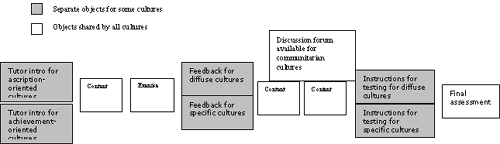
The
great advantage of object-based elearning is that once you have
identified some of the key dimensions for your major cultural
areas, you can deliver the same objects to those who share similar
traits. For example, you can deliver the same “ascription-oriented”
tutor introduction to audiences from Italy, Spain, Chile and Japan,
while you can distribute the achievement-oriented introduction
to North American, New Zealand, and Norwegian students.
Cultural
Adaptation? You Don’t Have a Choice!
Global
organizations need an efficient way of helping their people learn
constantly. Huge opportunities lie ahead if they are able to develop
diversity that can generate unique knowledge and expertise, elearning
could be a key part of making this happen. We need to stop assuming
that we all learn the same way and start devising a culturally
adaptive knowledge strategy.
Patrick
Dunn has 14 years experience in technology-based learning and
new media. He is currently Online Learning Manager for BMJ/Unified,
based in London, UK. He has worked with a number of major consulting
and e-learning organizations including DigitalThink and PricewaterhouseCoopers.
He is a regular presenter at industry bodies and conferences,
and contributor to industry journals. Contact him directly at
patrick@dunn.co.uk.
Alessandra
Marinetti is Senior Instructional Designer for DigitalThink, Inc.,
with 10 years of experience in education both in the private and
academic sector. She has worked as an instructor in the US, Germany,
and Italy and has extensive experience in cross-cultural communication.
Reach her at amarinetti@digitalthink.com
Copyright (c) 2000-2004 LiNE Zine (www.linezine.com)

 print
article
print
article